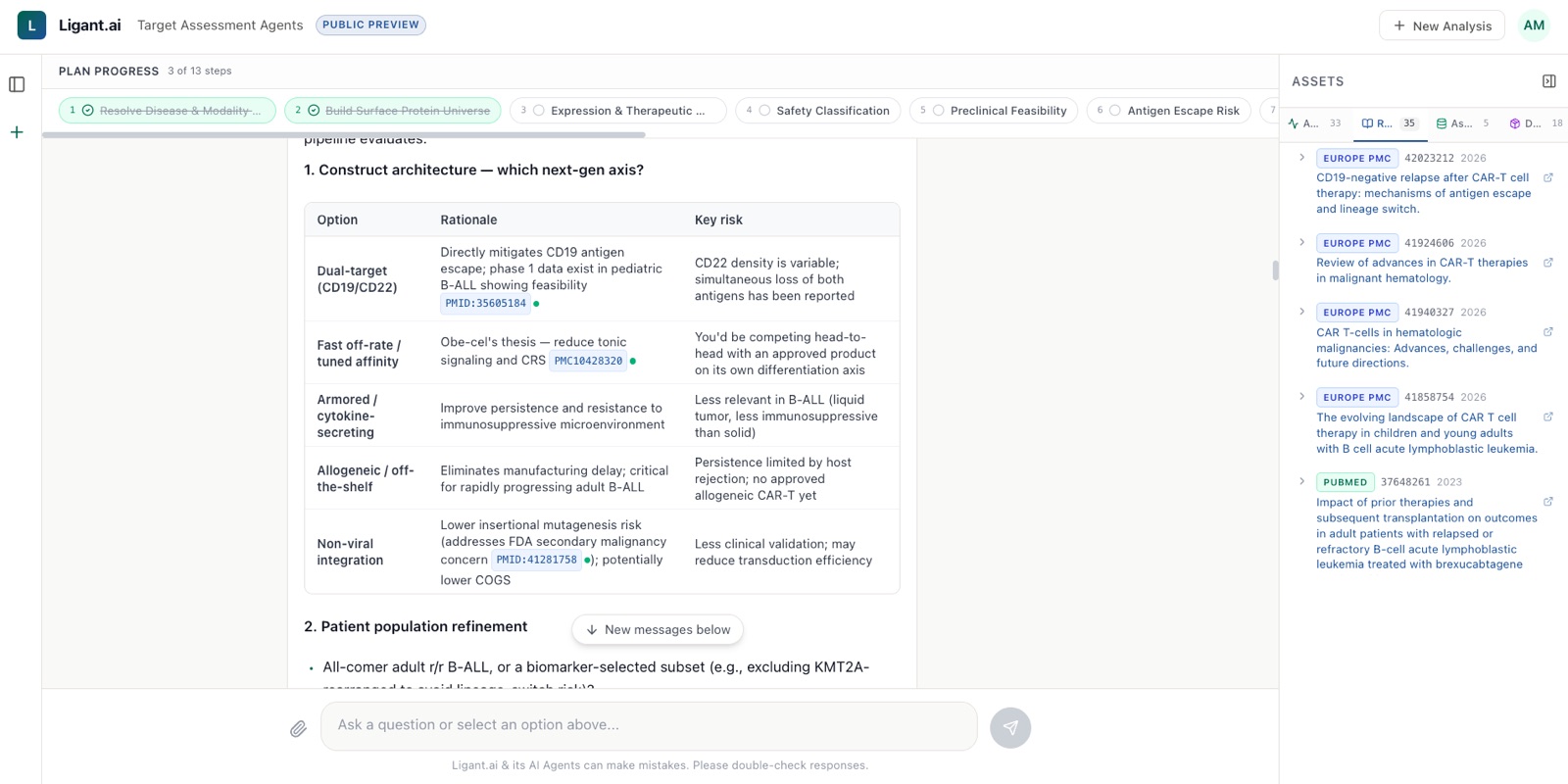
Consulting-grade CAR-T target evaluation for biotech founders — in weeks, not months. You know the biology. We help you prove the company. Ligant.ai runs the systematic evidence evaluation a top-tier firm charges $50K–$250K for, across 20+ biomedical databases, with every claim traced to its source.
30-minute live walkthrough. We’ll show you the agentic pipeline on BCMA and GPC3, and have a candid conversation about fit. Or apply for 500 free credits below.
Live walkthrough — CAR-T target assessment, end-to-end
General-purpose AI hallucinates. We built Ligant.ai so it can’t. Every number, every claim, every recommendation is anchored in a primary source. Every evidence we generate can be validated. Our goal is to reduce hallucination to zero — and every step we take is in service of that.
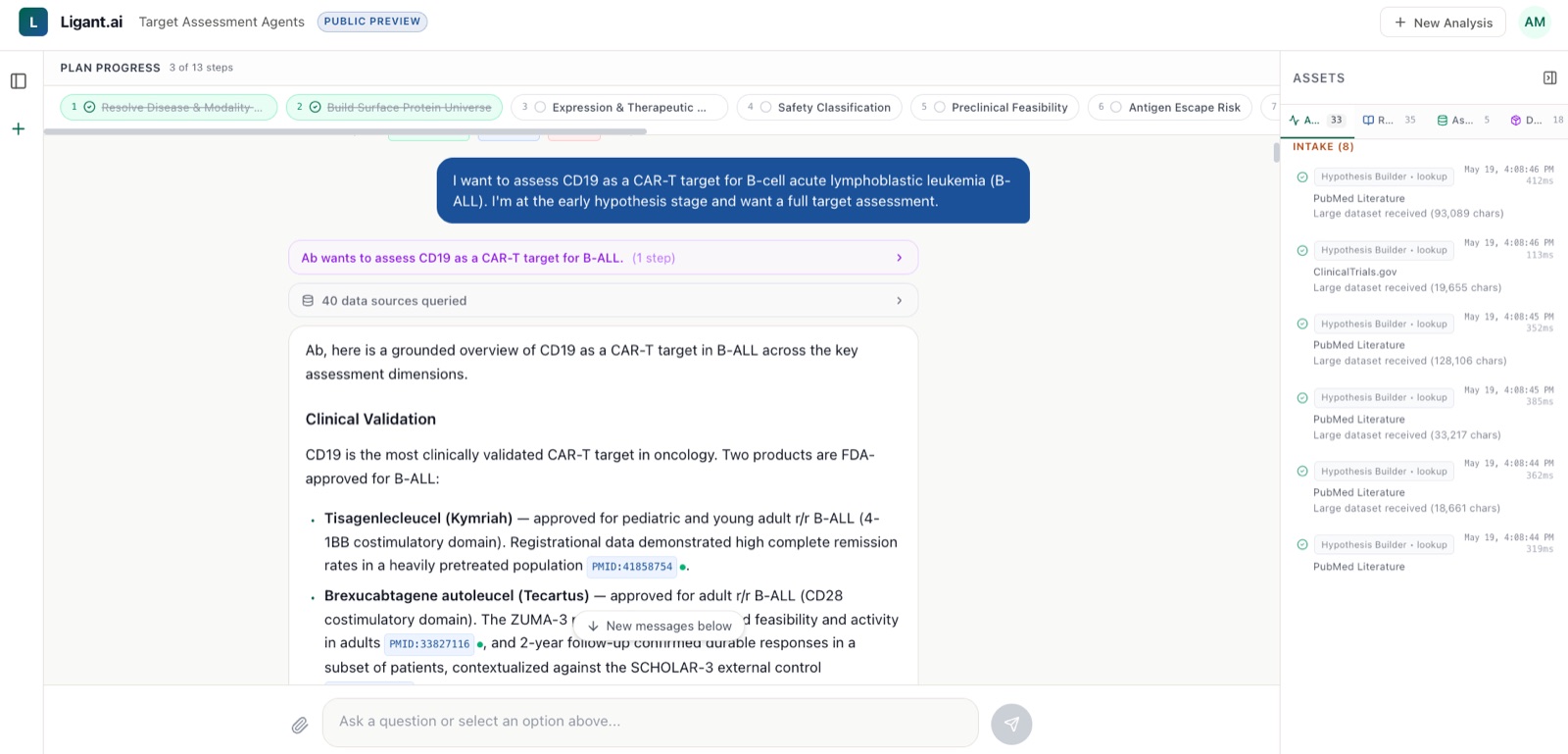
When the platform compares construct architectures, patient populations, or competitor strategies, every cell is backed by a citation. No paraphrased summaries divorced from their origin.
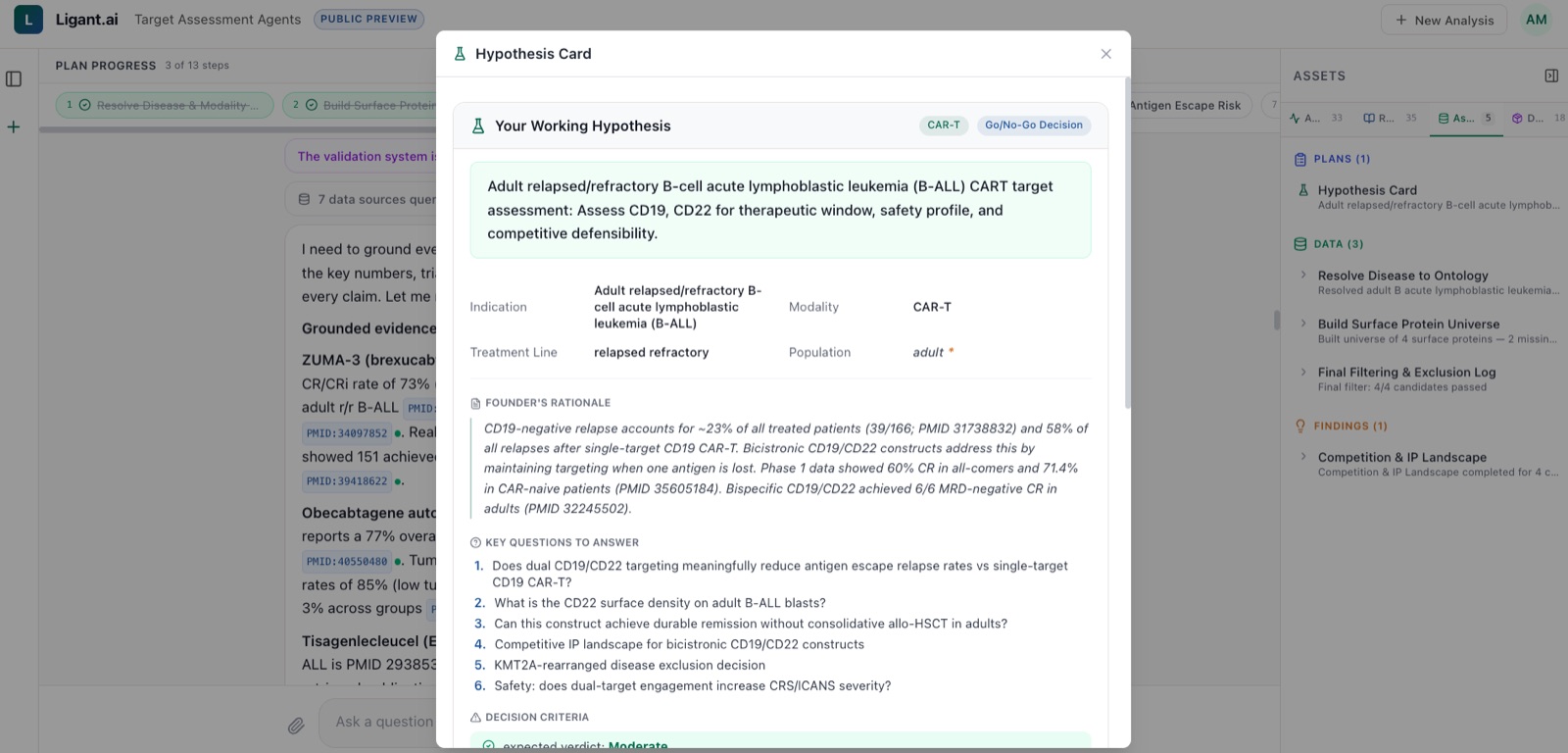
Hypothesis cards capture indication, modality, treatment line, and founder rationale — every claim cited, every assumption marked. Inferred fields are called out explicitly so nothing slips through unchecked.
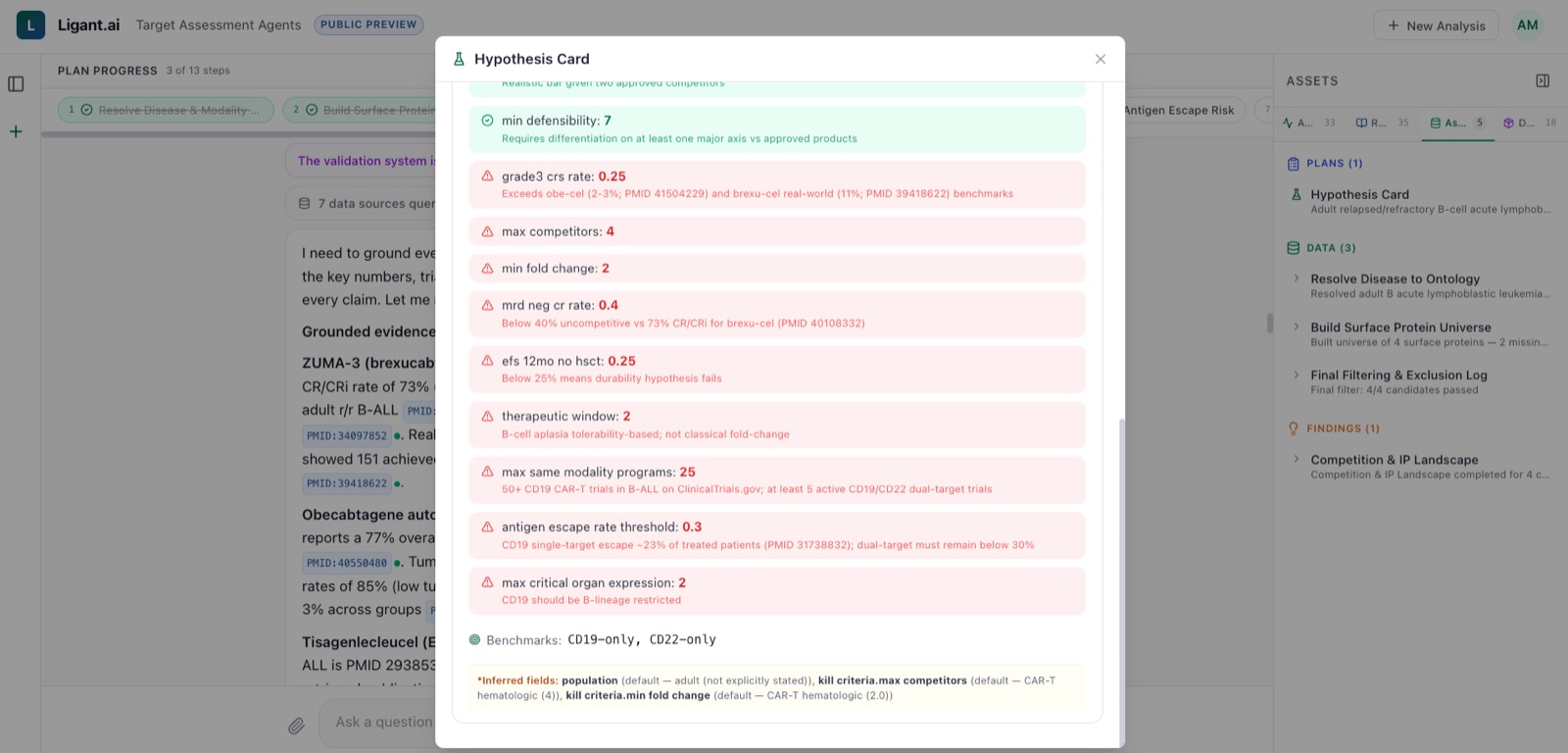
Every kill criterion — safety threshold, efficacy floor, competitive cutoff — is published alongside the benchmark it was derived from. You can audit, contest, or override any value before a gate decision is final.
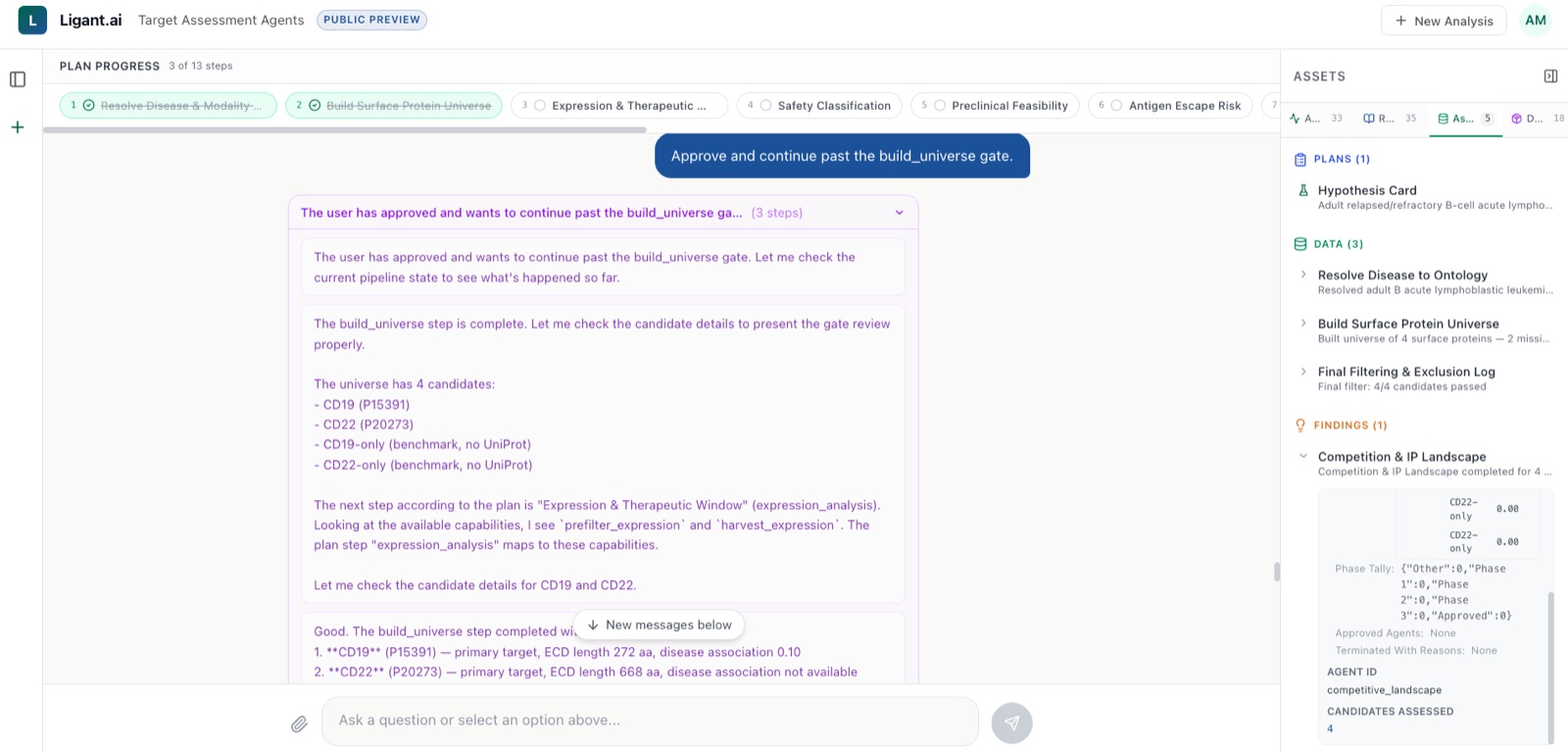
Watch each agent plan, query, and synthesize in real time. Every intake, retrieval, and decision is logged into the Assets panel — a complete audit trail you can replay, share with collaborators, or hand to a regulator.
Zero hallucination is the destination, not the claim. No system gets to zero on day one. What we promise is the audit trail to detect it, the citation infrastructure to challenge it, and a roadmap that prioritizes accuracy over speed at every gate.
You’ve spent a decade on a specific biology. You’ve identified the target. Now you need the evidence package an investor expects — genetics, expression, safety, competitive landscape, IP, TPP, market model — and you need it before you burn six months and a consulting retainer you don’t have.
No ISO standard, no FDA guideline, and no consensus SOP has ever defined computational target assessment for founders.
You bring the target. The platform runs the assessment. You make the call at each gate.
Each agent is a specialist. The orchestrator coordinates them through three decision gates. Your scientists review at every checkpoint. Nothing advances without human approval.
Agents don’t guess. They query TCGA, GTEx, HPA, UniProt, PDB, and 15 more authoritative databases. Every finding is cited to its source. When evidence is insufficient, agents flag uncertainty instead of fabricating.
Append-only evidence store. PROV-O-modeled provenance. Every query, tool call, and synthesis step is logged with timestamps and SHA-256 integrity hashes — the foundation for SOC 2 and 21 CFR Part 11 compliance on our post-MVP roadmap.
Agents do the work. Scientists make the calls. Human checkpoints are architectural gates. The pipeline halts until you review, adjust weights, and confirm. Decision-support, not decision-making.
A dedicated critique agent argues against the synthesis agent’s conclusions. Claims that fail citation verification are flagged, not delivered. Disagreement is a feature.
General-purpose AI hallucinates. In drug development, that’s not an inconvenience. It’s a risk. Ligant.ai uses a tiered model strategy: heavyweight reasoning for safety-critical assessments, mid-tier models for synthesis and competitive intelligence, lightweight models for high-throughput data retrieval. Model selection is based on catastrophic risk profile, not cost optimization.
A live status banner shows every database queried: green for success, yellow for partial, red for failed, gray for not applicable. You always know exactly what data informed the results and what was unavailable.
Claim-level citation verification. Interleaved reference-claim generation, not post-hoc citation. Synthesis agents compose only from retrieved evidence records — never from model parametric knowledge. When evidence is insufficient, agents flag uncertainty instead of fabricating.
When a database API fails or returns incomplete data, the pipeline continues, clearly marking what’s missing so you can calibrate confidence. No silent failures, no hidden gaps.
Automated fact-checking, cross-database validation, statistical correction (Benjamini-Hochberg), and human expert review work in sequence, so an error has to survive multiple independent checks to reach your team.
Append-only, cryptographically-integritied audit trails. Every query, every score, every human decision logged with timestamps and provenance. Your data never trains our models.
Ligant.ai is built for the domain experts closest to the science — the people who have already identified the target and now need to prove the company around it.
Pre-Series A founders validating a target hypothesis before writing the pitch deck. You’ve spent a decade on the biology; now you need the investor-grade evidence package.
Senior ex-pharma scientists joining an early team. Accelerate your own evaluation without retaining a consulting firm.
Rigorous second opinions for portfolio founders. Defensible, fully-cited evidence that backs — or challenges — the team’s thesis.
Coming in 2027: TCR-T, NK, ADC, and other cell therapy modalities. MVP focus: CAR-T.
Ligant.ai started in conversations with scientists in cell and gene therapy. The pattern was always the same. Hours spent combing through PubMed, ClinicalTrials.gov, and a dozen other databases, hunting for the evidence behind a single target call. No standard process. No shared workflow. Just spreadsheets, browser tabs, and judgment under pressure.
The frameworks existed — GOT-IT, target product profiles, decision rubrics used at top pharma — but no infrastructure to actually run them end-to-end. The best practices lived in slide decks, not software. So scientists rebuilt the wheel on every target, every time.
We took the best of those frameworks and built a multi-agent workflow around them. Every claim traced to its source. Every assessment scored against the same rubric. Every decision backed by evidence, provenance, and confidence scientists can stand behind — not in weeks, but on a regular basis.
This is what Pharma 5.0 looks like to us. Human-machine collaboration that gives scientists the speed, accuracy, and confidence to move the science forward. We’re building agentic systems for cell and gene therapy — target by target — to advance the field in the years ahead.
We are a team of scientists and engineers who have lived the problem we are solving. We built Ligant.ai because computational target assessment deserves a rigorous, reproducible workflow, not a patchwork of spreadsheets and ad hoc scripts. We build for the scientific community because we are part of it.
The next era of drug discovery is defined by human-AI collaboration. We are building toward a world where computational validation precedes every wet-lab experiment, where AI agents handle the data-intensive work, and where scientists focus on the decisions that matter.
Compress months of manual target evaluation into hours of automated, reproducible computation. Speed without sacrificing rigor.
Validate hypotheses computationally before committing resources to the wet lab. The wet lab becomes a faster execution and confirmation step, not the starting point.
AI agents handle data retrieval, scoring, and synthesis. Scientists review, direct, and decide. Neither replaces the other.
No standard workflow for computational target assessment has ever existed. We are committed to building and validating the first one, with the scientific community.
Product updates, scientific deep-dives, and what we’re learning as we build the first systematic workflow for computational target assessment.
We’re inviting a small cohort of CAR-T biotech founders to use the platform while we finalize the production release. 500 credits covers roughly a full target assessment across all three gates (Biology → Strategy → Economics), including the structured dossier and data-room-ready deliverables.
30-minute live walkthrough on BCMA and GPC3. Candid conversation about fit before any application.
Request a Demo CallFrom an idea about AI agents in life sciences to the first end-to-end pipeline for computational target assessment. Built methodically, validated rigorously.
Every claim in a Ligant.ai dossier traces back to an authoritative public source. These are the databases our agents query at runtime.
Genetics, drug-target associations, evidence aggregation across human disease biology.
Tumor-vs-normal expression across 44+ tissues, with protein-level evidence for safety calls.
Genome-scale essentiality screens across cancer cell lines to validate tumor dependency.
Every CAR-T trial worldwide, competitive landscape mapping, active program intelligence.
Pan-cancer genomic alteration context across published cohorts.
These are the public data foundations. We are building the agentic systems that make target assessment accessible, reproducible, and production-ready.
30-minute walkthrough of the agentic pipeline on BCMA and GPC3. Candid conversation about fit, where we could accelerate your work, and where we’re still maturing.
Already building? Apply for 500 free credits → · Want to talk directly? Contact us