Research Preview Request a Demo Call
Agentic AI for Target Assessment

Your virtual head of
target assessment.

Consulting-grade CAR-T target evaluation for biotech founders — in weeks, not months. You know the biology. We help you prove the company. Ligant.ai runs the systematic evidence evaluation a top-tier firm charges $50K–$250K for, across 20+ biomedical databases, with every claim traced to its source.

30-minute live walkthrough. We’ll show you the agentic pipeline on BCMA and GPC3, and have a candid conversation about fit. Or apply for 500 free credits below.

Learn more

The gap between domain expertise and investable conviction.

You’ve spent a decade on a specific biology. You’ve identified the target. Now you need the evidence package an investor expects — genetics, expression, safety, competitive landscape, IP, TPP, market model — and you need it before you burn six months and a consulting retainer you don’t have.

$50K–$250K
typical cost of a consulting-grade
target assessment dossier
8–16
weeks of expert time
for the same work by hand
0
tools built for pre-funded biotech
founders evaluating a candidate target

No ISO standard, no FDA guideline, and no consensus SOP has ever defined computational target assessment for founders.

One target. Three gates. A real decision.

You bring the target. The platform runs the assessment. You make the call at each gate.

01
Gate 1 — Biological Viability
Human and mouse genetics, pathway context, DepMap essentiality, tumor-vs-normal expression across 44+ tissues, antigen density, surface accessibility. Kill early if the biology doesn’t support the target.
02
Gate 2 — Strategic Viability
Organ-by-organ on-target/off-tumor risk, FAERS cross-modality signals, CRS/ICANS modeling, every CAR-T trial targeting the same antigen, IP chokepoints, differentiation thesis. Kill if the strategic case doesn’t hold.
03
Gate 3 — Economic Viability
Target Product Profile against approved CAR-T benchmarks, COGS, IND-enabling plan, market sizing, capital requirements to PoC, reimbursement pathway. Advance if it’s buildable, fundable, and viable.
“You know the biology. We help you prove the company.”
— The philosophy behind Ligant.ai

Agents collaborate. Humans decide.

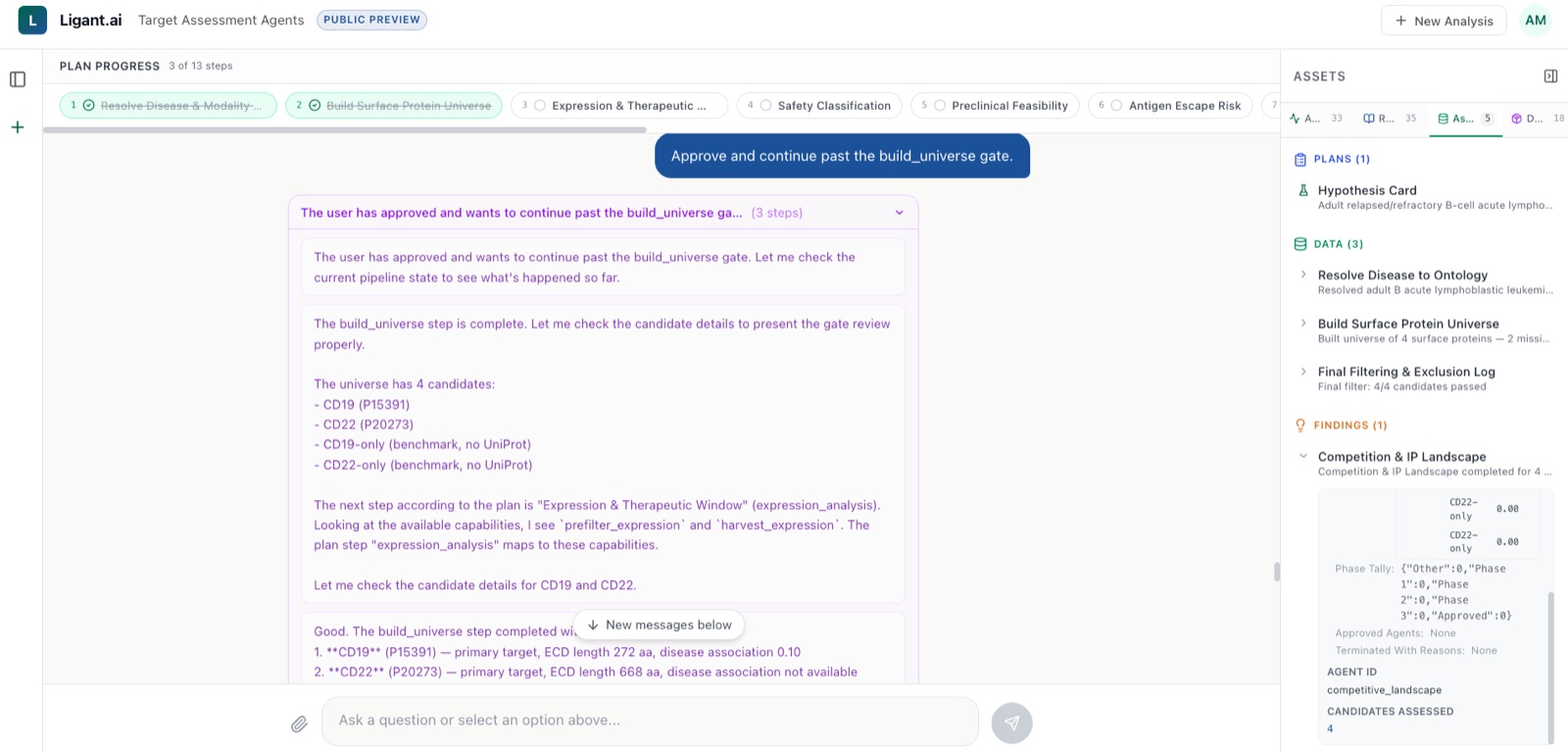
Each agent is a specialist. The orchestrator coordinates them through three decision gates. Your scientists review at every checkpoint. Nothing advances without human approval.

Agent
Intake
Capture target, indication, modality
Agents
Gate 1: Biology
Genetics, expression, essentiality
Human Gate
Review & Advance
Approve, pivot, or kill
Agents
Gate 2: Strategy
Safety, competition, IP
Human Gate
Review & Advance
Approve, pivot, or kill
Agents
Gate 3: Economics
TPP, COGS, market, plan
Human Gate
Evidence Dossier
Data-room-ready export

What makes agents different from a chatbot

Chatbot
You ask a question, you get an answer. No tools, no verification, no audit trail. You copy-paste into your next tool and start over.
Agentic AI
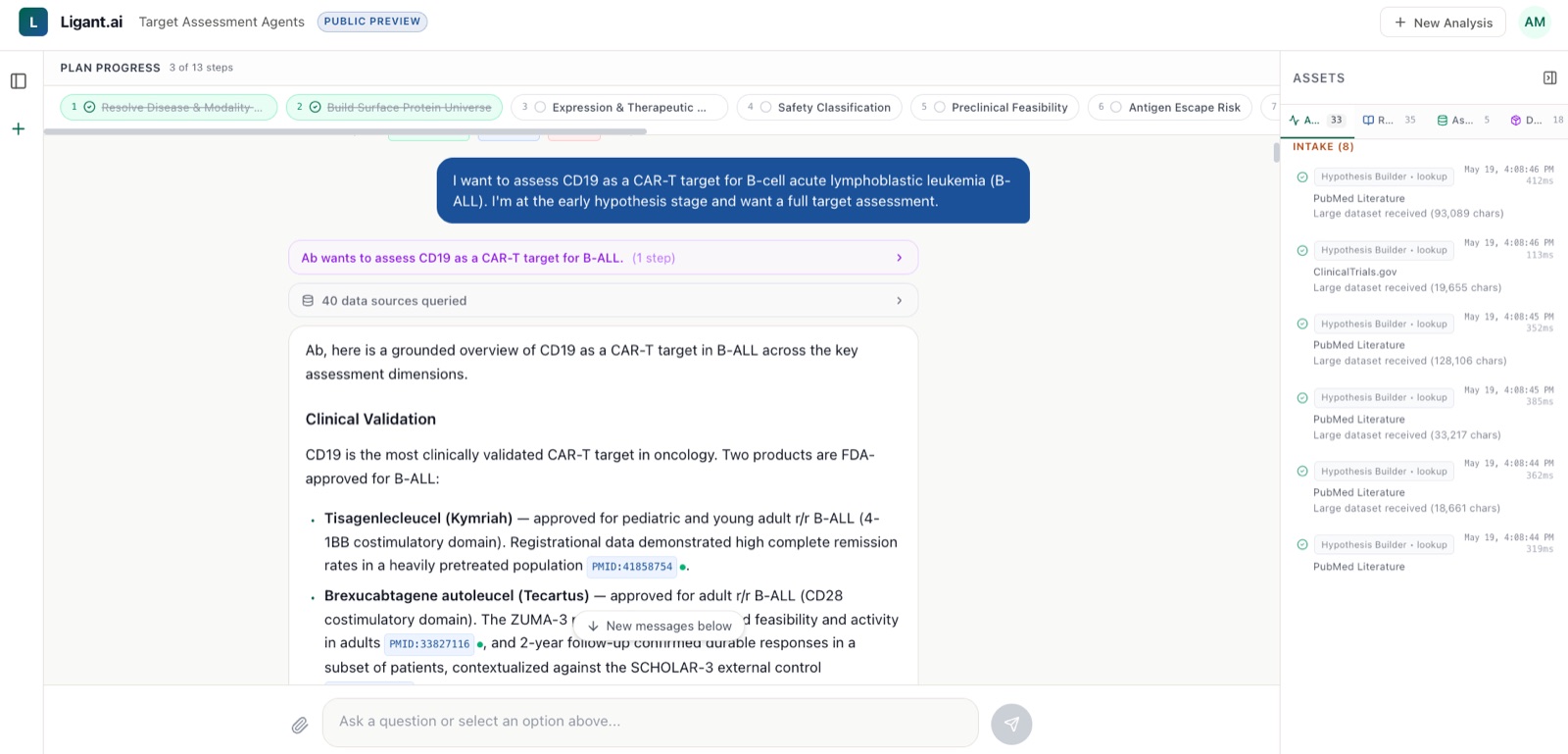
Agents use tools, query TCGA, GTEx, HPA, UniProt, PDB, ClinicalTrials.gov, and 14 more databases, pass structured results to each other, and produce verified outputs with full provenance. Every step is logged and traceable.
01

Every claim has a source

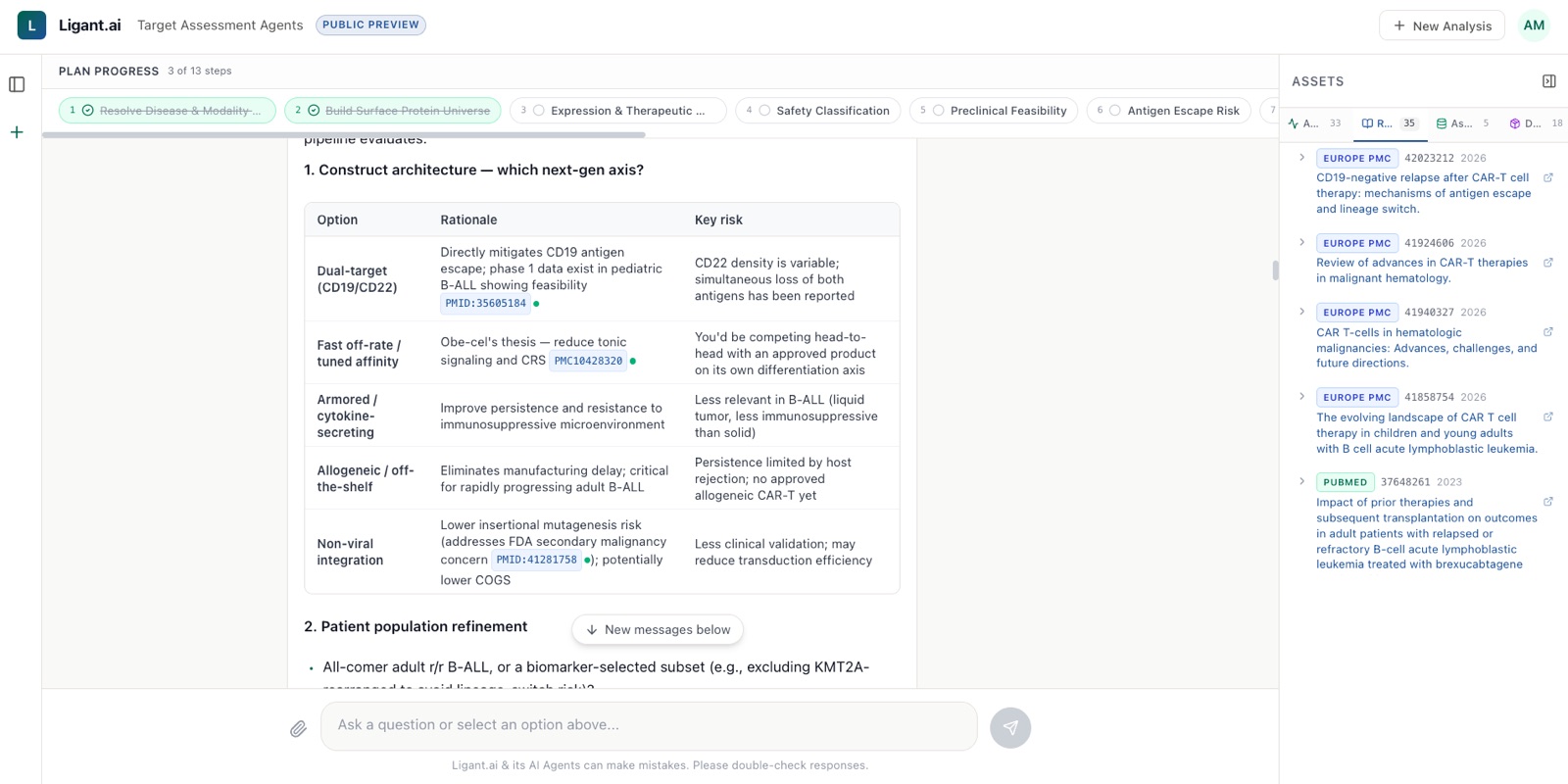
Agents don’t guess. They query TCGA, GTEx, HPA, UniProt, PDB, and 15 more authoritative databases. Every finding is cited to its source. When evidence is insufficient, agents flag uncertainty instead of fabricating.

02

Every action is logged

Append-only evidence store. PROV-O-modeled provenance. Every query, tool call, and synthesis step is logged with timestamps and SHA-256 integrity hashes — the foundation for SOC 2 and 21 CFR Part 11 compliance on our post-MVP roadmap.

03

Every decision is human

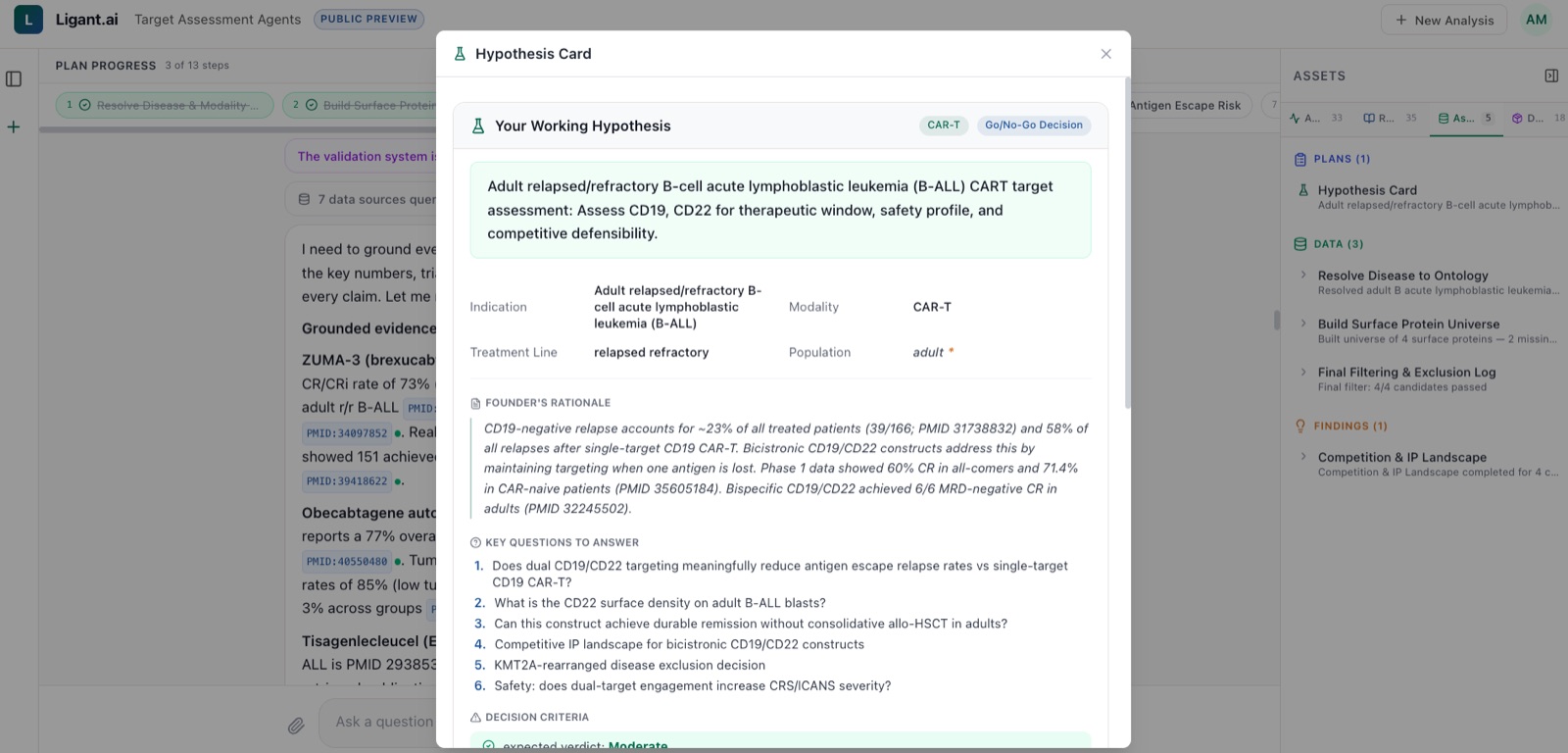
Agents do the work. Scientists make the calls. Human checkpoints are architectural gates. The pipeline halts until you review, adjust weights, and confirm. Decision-support, not decision-making.

04

Every synthesis is critiqued

A dedicated critique agent argues against the synthesis agent’s conclusions. Claims that fail citation verification are flagged, not delivered. Disagreement is a feature.

20+ databases. Tiered AI models. Full transparency.

General-purpose AI hallucinates. In drug development, that’s not an inconvenience. It’s a risk. Ligant.ai uses a tiered model strategy: heavyweight reasoning for safety-critical assessments, mid-tier models for synthesis and competitive intelligence, lightweight models for high-throughput data retrieval. Model selection is based on catastrophic risk profile, not cost optimization.

Data source transparency

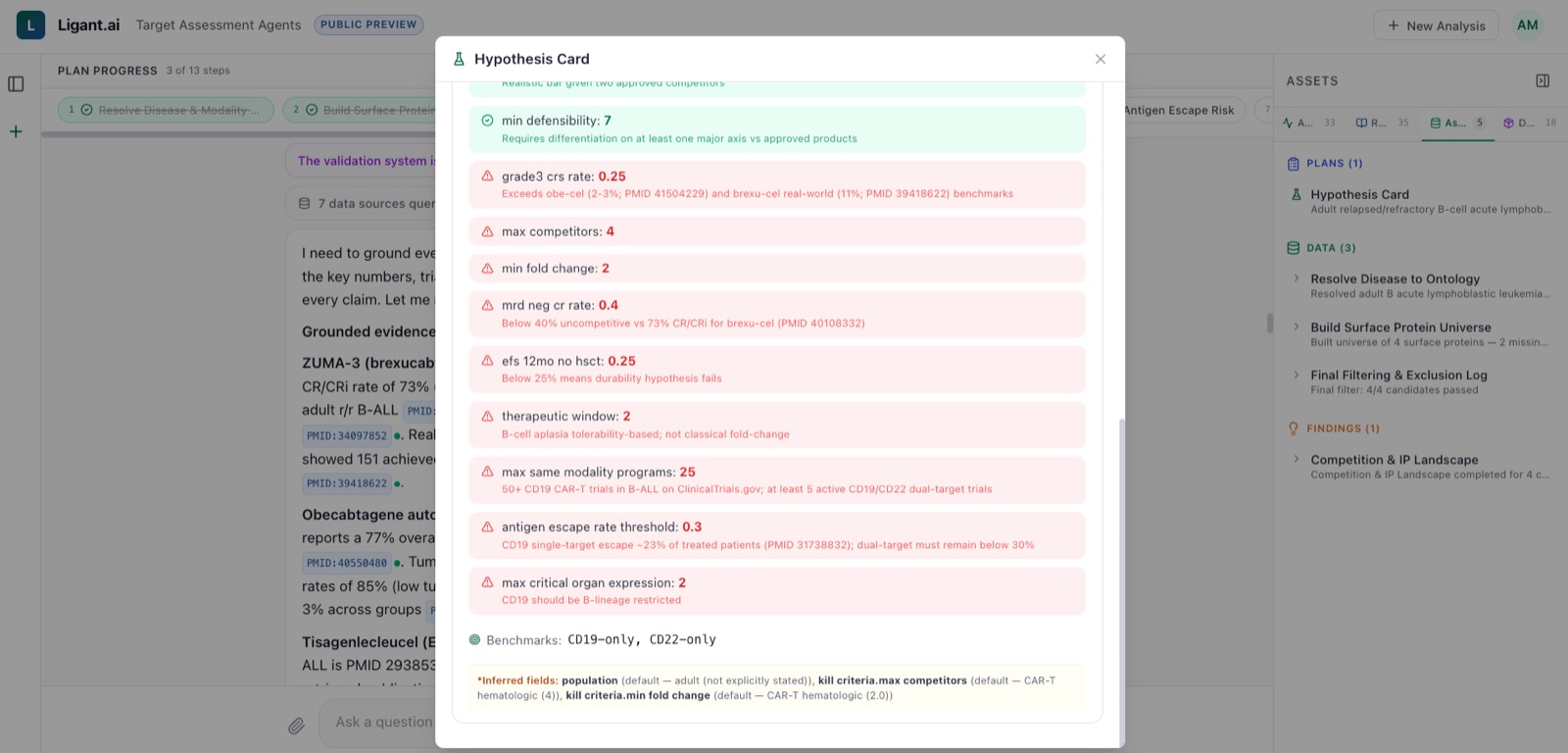
A live status banner shows every database queried: green for success, yellow for partial, red for failed, gray for not applicable. You always know exactly what data informed the results and what was unavailable.

Built to reduce hallucination

Claim-level citation verification. Interleaved reference-claim generation, not post-hoc citation. Synthesis agents compose only from retrieved evidence records — never from model parametric knowledge. When evidence is insufficient, agents flag uncertainty instead of fabricating.

Graceful degradation

When a database API fails or returns incomplete data, the pipeline continues, clearly marking what’s missing so you can calibrate confidence. No silent failures, no hidden gaps.

Layered verification architecture

Automated fact-checking, cross-database validation, statistical correction (Benjamini-Hochberg), and human expert review work in sequence, so an error has to survive multiple independent checks to reach your team.

Scientific accuracy is not a feature we added. It’s the architecture we built everything on.

Integrity-hashed audit trails

Append-only, cryptographically-integritied audit trails. Every query, every score, every human decision logged with timestamps and provenance. Your data never trains our models.

Founders who already know their target

Ligant.ai is built for the domain experts closest to the science — the people who have already identified the target and now need to prove the company around it.

Domain-expert founders

Pre-Series A founders validating a target hypothesis before writing the pitch deck. You’ve spent a decade on the biology; now you need the investor-grade evidence package.

Scientific co-founders

Senior ex-pharma scientists joining an early team. Accelerate your own evaluation without retaining a consulting firm.

Advisory boards & SAB members

Rigorous second opinions for portfolio founders. Defensible, fully-cited evidence that backs — or challenges — the team’s thesis.

Coming in 2027: TCR-T, NK, ADC, and other cell therapy modalities. MVP focus: CAR-T.

Scientists building for scientists

We are a team of scientists and engineers who have lived the problem we are solving. We built Ligant.ai because computational target assessment deserves a rigorous, reproducible workflow, not a patchwork of spreadsheets and ad hoc scripts. We build for the scientific community because we are part of it.

Our Vision: Pharma 5.0

The next era of drug discovery is defined by human-AI collaboration. We are building toward a world where computational validation precedes every wet-lab experiment, where AI agents handle the data-intensive work, and where scientists focus on the decisions that matter.

01

Accelerate assessment timelines

Compress months of manual target evaluation into hours of automated, reproducible computation. Speed without sacrificing rigor.

02

The dry lab as first pass

Validate hypotheses computationally before committing resources to the wet lab. The wet lab becomes a faster execution and confirmation step, not the starting point.

03

Human-AI collaboration with agentic systems

AI agents handle data retrieval, scoring, and synthesis. Scientists review, direct, and decide. Neither replaces the other.

04

Solving an industry problem

No standard workflow for computational target assessment has ever existed. We are committed to building and validating the first one, with the scientific community.

Research Preview — 500 credits, free

We’re inviting a small cohort of CAR-T biotech founders to use the platform while we finalize the production release. 500 credits covers roughly a full target assessment across all three gates (Biology → Strategy → Economics), including the structured dossier and data-room-ready deliverables.

What you get

  • Up to 500 credits of platform usage — approximately one full target assessment
  • Structured evidence dossier with every claim cited to its source
  • All three-gate decision briefs (Biological, Strategic, Economic Viability)
  • Data-room-ready export (Word + PDF) mapped to the three-tier investor access structure
  • Direct Slack access to the engineering team
  • Co-development opportunities on validation publications

Who we’re looking for

  • Founders or founding scientists evaluating a specific CAR-T target
  • Pre-seed to Series A stage
  • Willing to share anonymized feedback on dossier quality

Start with a demo call

30-minute live walkthrough on BCMA and GPC3. Candid conversation about fit before any application.

Request a Demo Call
Or apply directly

We review every application personally. Preview access is limited.

Two years in the making

From an idea about AI agents in life sciences to the first end-to-end pipeline for computational target assessment. Built methodically, validated rigorously.

July 2024
The Idea
AI agents for life sciences
H2 2024
AI Agent Experiments
Exploring agentic workflows for life sciences
H1 2025
AI Model Research
Domain-specific model strategy and evaluation
H2 2025
Agent Framework
Multi-agent orchestration, early benchmarks
Q1 2026
Target Assessment
Pipeline architecture and 20+ database integration
Feb 2026
Ligant.ai Incorporated
The company is officially born
March 2026
Research Preview
500-credit preview with founder cohort
Q3 2026
Compliance & Validation
SOC 2, GxP audit trails
Late 2026
Production Launch

Built on the data foundations of biomedicine

Every claim in a Ligant.ai dossier traces back to an authoritative public source. These are the databases our agents query at runtime.

Open Targets

Genetics, drug-target associations, evidence aggregation across human disease biology.

Human Protein Atlas

Tumor-vs-normal expression across 44+ tissues, with protein-level evidence for safety calls.

DepMap

Genome-scale essentiality screens across cancer cell lines to validate tumor dependency.

ClinicalTrials.gov

Every CAR-T trial worldwide, competitive landscape mapping, active program intelligence.

cBioPortal

Pan-cancer genomic alteration context across published cohorts.

These are the public data foundations. We are building the agentic systems that make target assessment accessible, reproducible, and production-ready.

See It In Action

Ready to assess your target?

30-minute walkthrough of the agentic pipeline on BCMA and GPC3. Candid conversation about fit, where we could accelerate your work, and where we’re still maturing.

Request a Demo Call

Already building? Apply for 500 free credits → · Want to talk directly? Contact us